Understanding The Technology Behind Heat Pumps
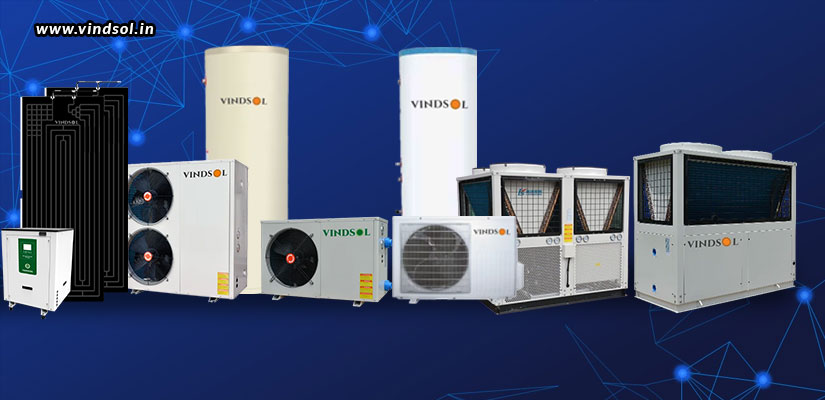
Vindsol, an innovative leader in environment-friendly heating solutions, owned and run by professionals dedicated to harnessing nature’s energy. Located in Bangalore, the company has led the way in supplying cutting-edge heating technology since 2017.
As homeowners and businesses increasingly pursue energy-efficient options for heating and cooling, heat pumps have emerged as a prominent sustainable alternative to conventional heating systems. Unlike traditional water heaters or HVAC systems that produce heat through fuel combustion or high electricity consumption, heat pumps operate by transferring heat from one location to another, resulting in exceptional efficiency. This blog explores the working principles of heat pumps, the science of heat transfer, key components involved, and their potential to lead the way in sustainable technology.
The science of heat transfer
Heat pumps function based on the core principle of heat transfer, grounded in thermodynamic laws, by relocating heat from one source (such as air, ground, or water) to another using a minimal amount of electricity instead of generating heat directly. In nature, heat naturally moves from warmer regions to cooler ones; however, heat pumps invert this natural process through a refrigeration cycle, enabling the extraction of heat from the environment and its transfer to where it is required. The refrigeration cycle comprises four essential stages:
Evaporation, during which the refrigerant absorbs heat and transforms into a gas
Compression, which elevates its temperature
Condensation, where the heated refrigerant releases heat into the heating system as it reverts to a liquid
Expansion, which reduces its temperature before it re-enters the evaporator to commence the cycle anew.
This ongoing cycle allows heat pumps to provide heat efficiently while utilizing minimal electrical energy.
Key components of a heat pump
A heat pump is composed of several essential components that collaborate to enable effective heat transfer.
Evaporator coil: This component absorbs heat from the surrounding air, water, or ground. The refrigerant within the coil evaporates as it takes in heat, transitioning from a liquid state to a gaseous state.
Compressor: The compressor elevates the temperature of the gaseous refrigerant by compressing it, ensuring it reaches a temperature suitable for efficient heat transfer.
Condenser coil: The condenser coil is responsible for releasing heat into the heating system. As the refrigerant cools, it condenses back into a liquid form.
Expansion valve: This valve lowers the pressure of the refrigerant, cooling it before it re-enters the evaporator coil, thus restarting the cycle.
Reversing valve: In air-source heat pumps, the reversing valve enables the system to alternate between heating and cooling modes. During warmer months, the heat pump extracts heat from the interior of the building and expels it outside, functioning similarly to an air conditioner.
Heat pumps – The technology of the future
As heat pump technology advances, innovations are enhancing their efficiency and user-friendliness. Modern smart heat pumps are equipped with AI-driven controls and intelligent thermostats, allowing users to optimize heating schedules for improved energy savings. Hybrid systems that combine heat pumps with solar panels minimize dependence on grid electricity, achieving nearly zero operating costs. Furthermore, adaptations for cold climates, featuring advanced refrigerants and defrosting systems, enable newer models to sustain efficiency even in extremely low temperatures, establishing heat pumps as a dependable and sustainable heating solution in diverse environments.
As the global community shifts towards more sustainable energy alternatives, heat pumps are set to be instrumental in developing environmentally friendly and energy-efficient environments. For those seeking a modern, economical, and sustainable heating option, a Vindsol heat pump in Bangalore represents a wise investment for the future. With exceptional efficiency and potential for long-term savings, Vindsol's heat pumps deliver dependable performance while minimizing carbon emissions and energy expenses. Consider upgrading to a Vindsol heat pump today to enjoy the advantages of innovative and sustainable heating technology!
Resource: Read more


